Hướng dẫn xử lý dạng bài Matching Headings trong IELTS Reading
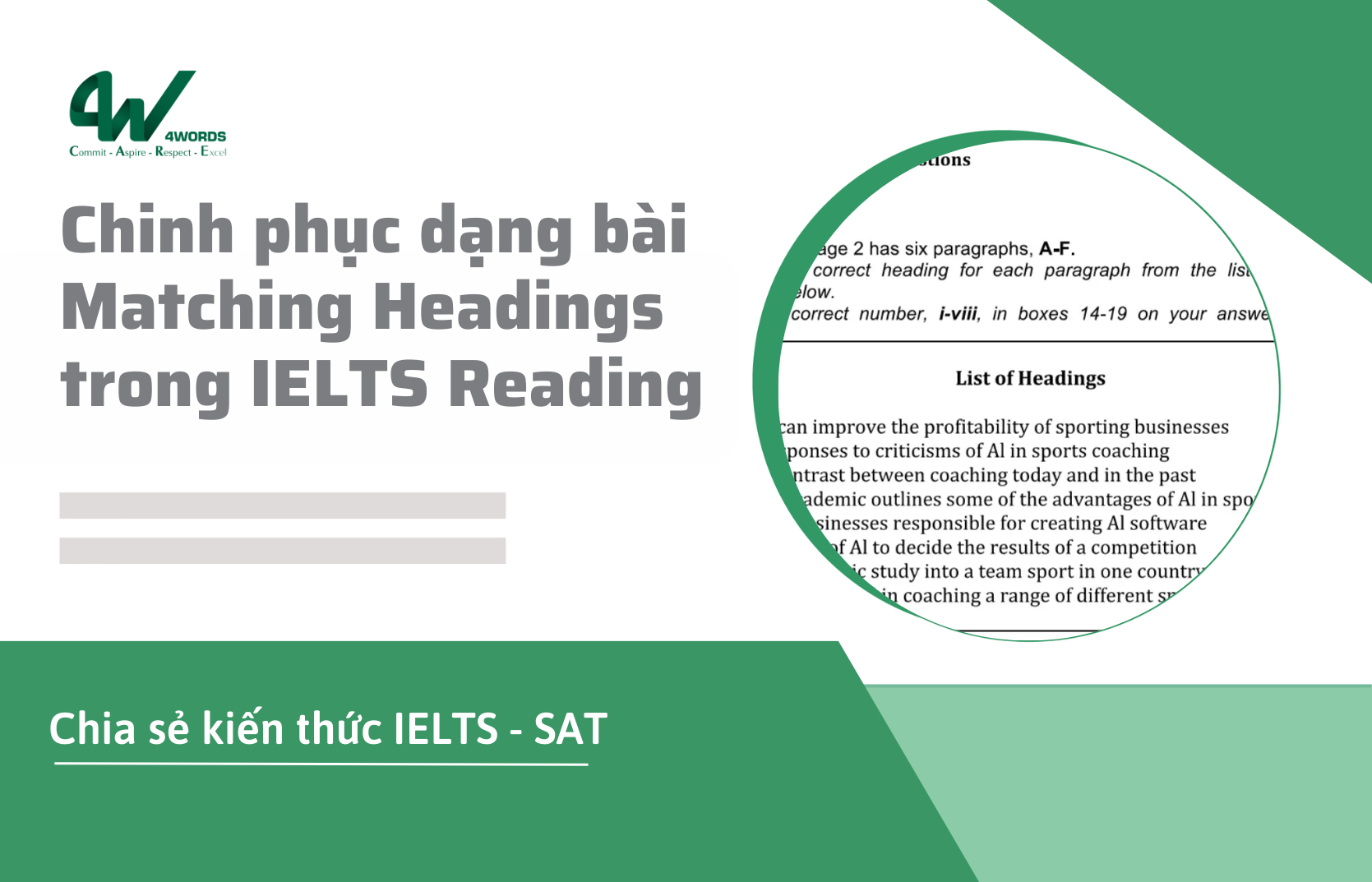
Matching Headings có lẽ là một trong những dạng bài gây ám ảnh nhất đối với thí sinh IELTS Reading. Bạn cảm thấy choáng ngợp trước hàng loạt tiêu đề và không biết sắp xếp chúng theo từng đoạn văn như thế nào? Bạn cảm thấy khó khăn khi đọc và xác định ý chính của từng đoạn văn? Cùng 4WORDS điểm qua một số bí quyết để xử lý thật tốt dạng bài Matching Headings này nhé!
-
Bước 1: Đọc tiêu đề trong bài Matching Headings
Headings có thể được coi như phiên bản rút gọn của đoạn văn. Do vậy, đôi khi các tiêu đề cho sẵn có thể sẽ gây khó khăn cho thí sinh khi làm Matching Headings. Ngoài ra, số lượng tiêu đề thường nhiều hơn số lượng đoạn văn, khiến cho quá trình làm bài trở nên khó khăn hơn.
Trước tiên đọc đoạn văn, bạn hãy đọc trước và giải nghĩa từng tiêu đề cho sẵn. Bạn có thể hình dung xem nội dung đoạn văn gắn với tiêu đề đó sẽ như thế nào, từ đó giúp bạn có được một cái nhìn rõ ràng hơn trong quá trình đọc và làm bài.
Cùng phân tích ví dụ sau:
i The search for the reasons for an increase in population
(Đoạn văn này mô tả quá trình tìm ra nguyên nhân dẫn đến tăng trưởng dân số)
ii Industrialisation and the fear of unemployment
(Đoạn văn này nói về quá trình công nghiệp hóa và nguy cơ thất nghiệp do hiện tượng này gây ra)
iii The development of cities in Japan
(Đoạn văn này mô tả sự phát triển đô thị tại Nhật bản)
iv The time and place of the Industrial Revolution
(Đoạn văn này đề cập tới thời gian và nơi diễn ra cuộc cách mạng công nghiệp)
v The cases of Holland, France and China
(Đoạn văn này đưa ra ví dụ cho đoạn văn trước đó. Các địa điểm được đề cập là Hà Lan, Pháp, và Trung Quốc)
vi Changes in drinking habits in Britain
(Đoạn văn này nói về thay đổi trong thói quen uống ở Anh)
vii Two keys to Britain’s industrial revolution
(Đoạn văn này giải thích hai lý do chính dẫn đến cuộc cách mạng công nghiệp)
viii Conditions required for industrialisation
(Đoạn văn này nhắc đến những điều kiện cần có để diễn ra cuộc cách mạng công nghiệp)
ix Comparisons with Japan lead to the answer
(Đoạn văn này lấy ví dụ tại Nhật Bản và đưa ra phép so sánh để tìm ra câu trả lời cho đoạn văn trước đó)
-
Bước 2: Skim nhanh bài đọc để tìm ý chính từng đoạn trong bài Matching Headings
Tiếp theo, bạn cần đọc tiêu đề chính của bài đọc và skim nhanh các đoạn văn để tìm ra ý chính của từng đoạn là gì. Lưu ý do đây là skimming, bạn không cần phải đọc kĩ toàn bộ các thông tin quá chi tiết, số liệu, ví dụ, đoạn trích, hay các nội dung có tính giải thích, kể lể. Tuy nhiên, bạn không nên chủ quan và cho rằng skimming là đọc mỗi câu đầu và câu cuối của đoạn văn. Tư duy này hoàn toàn không chính xác với IELTS, do nội dung chính của từng đoạn có thể nằm ở bất kì vị trí nào trong bài đọc.
Cùng phân tích các ví dụ sau:
Title: Tea and the Industrial Revolution (Trà và cuộc cách mạng công nghiệp)
Tóm tắt: A Cambridge professor says that a change in drinking habits was the reason for the Industrial Revolution in Britain. Anjana Abuja reports. (Theo Anjana Abuja, một giáo sư đại học Cambridge tuyên bố rằng nguyên nhân dẫn đến cuộc cách mạng tại Anh là do thay đổi trong thói quen uống)
A.
Alan Macfarlane, professor of anthropological science at King’s College, Cambridge has, like other historians, spent decades wrestling with the enigma of the Industrial Revolution. Why did this particular Big Bang – the world-changing birth of industry - happen in Britain? And why did it strike at the end of the 18th century?
→ Đoạn văn này khá ngắn nên bạn có thể đọc và dịch toàn bộ: Alan Macfarlane, Giáo sư khoa học khảo cổ tại đại học King’s College, Cambridge, đã dành hàng thập kỷ vật lộn với sự kì bí của cuộc cách mạng công nghiệp. Vì sao “cú nổ lớn” này - thời điểm sinh ra ngành công nghiệp làm rung chuyển cả thế giới - lại diễn ra ở Anh? Và tại sao nó xuất hiện vào cuối thế kỉ 18?
Hai chi tiết quan trọng trong đoạn văn này là “happen in Britain” (nơi diễn ra cuộc cách mạng công nghiệp) và “at the end of the 18th century” (thời điểm xảy ra). Do vậy, tiêu đề iv phù hợp nhất với đoạn A.
B.
Macfarlane compares the puzzle to a combination lock. ‘There are about 20 different factors and all of them need to be present before the revolution can happen,’ he says. For industry to take off, there needs to be the technology and power to drive factories, large urban populations to provide cheap labour, easy transport to move goods around, an affluent middle-class willing to buy mass-produced objects, a market-driven economy and a political system that allows this to happen. While this was the case for England, other nations, such as Japan, the Netherlands and France also met some of these criteria but were not industrialising. All these factors must have been necessary. But not sufficient to cause the revolution, says Macfarlane. ‘After all, Holland had everything except coal while China also had many of these factors. Most historians are convinced there are one or two missing factors that you need to open the lock.’
→ Đoạn văn này rất dài. Tuy nhiên, nếu loại bỏ các thông tin mang tính giải thích và ví dụ, người đọc có thể suy luận ra thông tin quan trọng nhất trong đoạn văn này nằm ở câu sau:
“Macfarlane compares the puzzle to a combination lock.” (Macfarlane ví bài toán này như việc phá vỡ một chiếc ổ khóa kết hợp) và “All these factors must have been necessary. But not sufficient to cause the revolution, says Macfarlane” (Chắc rằng những yếu tố này là thiết yếu, nhưng chưa đủ để có thể dẫn đến cuộc cách mạng).
Từ hai thông tin quan trọng này, người đọc có thể suy luận tiêu đề phù hợp nhất là tiêu đề viii.
C.
The missing factors, he proposes, are to be found in almost every kitchen cupboard. Tea and beer, two of the nation’s favourite drinks, fuelled the revolution. The antiseptic properties of tannin, the active ingredient in tea, and of hops in beer – plus the fact that both are made with boiled water – allowed urban communities to flourish at close quarters without succumbing to water-borne diseases such as dysentery. The theory sounds eccentric but once he starts to explain the detective work that went into his deduction, the scepticism gives way to wary admiration. Macfarlane's case has been strengthened by support from notable quarters – Roy Porter, the distinguished medical historian, recently wrote a favourable appraisal of his research.
→ Nội dung chính của đoạn nằm ngay ở câu đầu tiên: “The missing factors, he proposes, are to be found in almost every kitchen cupboard. Tea and beer, two of the nation’s favourite drinks, fuelled the revolution.” (Theo Macfarlane, yếu tố còn lại có thể được tìm thấy trong mọi cái tủ đựng bát đũa. Hai món đồ uống yêu thích của người Anh - trả và bia - đã “châm ngòi” cho cuộc cách mạng diễn ra). Do vậy, người đọc có thể suy luận đáp án cho đoạn văn này là tiêu đề số iv.
-
Bài tập Matching Headings tự luyện:
4WORDS mời bạn đọc cùng thử sức với các đoạn văn Matching Headings còn lại. Phần đáp án và giải thích nằm ở phía cuối bài viết này:
D.
Macfarlane had wondered for a long time how the Industrial Revolution came about. Historians had alighted on one interesting factor around the mid-18th century that required explanation. Between about 1650 and 1740, the population in Britain was static. But then there was a burst in population growth. Macfarlane says: ‘The infant mortality rate halved in the space of 20 years, and this happened in both rural areas and cities, and across all classes. People suggested four possible causes. Was there a sudden change in the viruses and bacteria around? Unlikely. Was there a revolution in medical science? But this was a century before Lister’s revolution*. Was there a change in environmental conditions? There were improvements in agriculture that wiped out malaria, but these were small gains. Sanitation did not become widespread until the 19th century. The only option left is food. But the height and weight statistics show a decline. So the food must have gotten worse. Efforts to explain this sudden reduction in child deaths appeared to draw a blank .’
E.
This population burst seemed to happen at just the right time to provide labour for the Industrial Revolution. ‘When you start moving towards an industrial revolution, it is economically efficient to have people living close together,’ says Macfarlane. ‘But then you get diseases, particularly from human waste.’ Some digging around in historical records revealed that there was a change in the incidence of water-borne disease at that time, especially dysentery. Macfarlane deduced that whatever the British were drinking must have been important in regulating disease. He says, ‘We drank beer. For a long time, the English were protected by the strong antibacterial agent in hops, which were added to help preserve the beer. But in the late 17th century a tax was introduced on malt, the basic ingredient of beer. The poor turned to water and gin and in the 1720s the mortality rate began to rise again. Then it suddenly dropped again. What caused this?’
F.
Macfarlane looked to Japan, which was also developing large cities about the same time, and also had no sanitation. Water-borne diseases had a much looser grip on the Japanese population than those in Britain. Could it be the prevalence of tea in their culture? Macfarlane then noted that the history of tea in Britain provided an extraordinary coincidence of dates. Tea was relatively expensive until Britain started a direct clipper trade with China in the early 18th century. By the 1740s, about the time that infant mortality was dipping, the drink was common. Macfarlane guessed that the fact that water had to be boiled, together with the stomach-purifying properties of tea meant that the breast milk provided by mothers was healthier than it had ever been. No other European nation sipped tea like the British, which, by Macfarlanes logic, pushed these other countries out of contention for the revolution.
G.
But, if tea is a factor in the combination lock, why didn’t Japan forge ahead in a tea-soaked industrial revolution of its own? Macfarlane notes that even though 17th-century Japan had large cities, high literacy rates, even a futures market, it had turned its back on the essence of any work-based revolution by giving up labour-saving devices such as animals, afraid that they would put people out of work. So, the nation that we now think of as one of the most technologically advanced entered the 19th century having ‘abandoned the wheel’.
Đáp án và giải thích bài Matching Headings:
Đoạn D. i
Nội dung chính: But then there was a burst in population growth…People suggested four possible causes.
Đoạn E. vi
Nội dung chính: Some digging around in historical records revealed that there was a change in the incidence of water-borne disease at that time, especially dysentery. Macfarlane deduced that whatever the British were drinking must have been important in regulating disease.
Đoạn F. ix
Nội dung chính: Macfarlane looked to Japan, which was also developing large cities about the same time, and also had no sanitation.
Đoạn G. ii
Nội dung chính: But, if tea is a factor in the combination lock, why didn’t Japan forge ahead in a tea-soaked industrial revolution of its own?...it had turned its back on the essence of any work-based revolution by giving up labour-saving devices
Mọi hỗ trợ cần tới về việc học thi IELTS, quý phụ huynh và các bạn học sinh, sinh viên có thể liên hệ với 4WORDS để nhận những trợ giúp nhiệt tình, chính xác từ nhà đào tạo dẫn đầu thành tích!
1100+ học viên 4WORDS đã thi thật đạt 7.0-8.5 IELTS và 1450-1590 SAT; đội ngũ thầy cô tận tâm, chuyên môn xuất sắc, là các ngôi sao sáng trong làng Anh ngữ, các Á quân, Quán quân từ các cuộc thi tiếng Anh lớn cấp trường và cấp quốc gia. 4WORDS rất hy vọng được sớm gặp gỡ để cùng học trò chinh phục mọi mục tiêu học tập GỌN GÀNG, XUẤT SẮC!
Tin Liên quan
Xu hướng đề thi IELTS 2025-2026 và định hướng ôn tập
Xu hướng IELTS trong năm 2025, đặc biệt là Speaking và Writing, 4WORDS nhận thấy yêu cầu đang được tăng cao, việc chấm thi cũng khắt khe hơn. Trong khi cấu trúc đề thi không thay đổi và nội...
18/12/2025Các loại máy tính được dùng khi thi SAT
SAT Math là phần thi duy nhất của bài thi SAT được dùng máy tính. So với phần thi không dùng máy tính, phần thi dùng máy tính trong đề thi SAT Math vẫn chiếm phần lớn thời gian...
06/10/2021Một số cách phát triển ý trong IELTS Speaking
Trường hợp tệ nhất khi đi thi IELTS Speaking có lẽ là khi bạn không có gì để nói về chủ đề được giao. Nếu rơi vào tình huống ấy, bạn sẽ làm gì? Đương nhiên là bạn vẫn...
18/11/20206 tips cho phần Toán SAT không dùng máy tính
Nhiều học sinh chắc hẳn đã quen với việc sử dụng máy tính mỗi khi làm Toán. Thậm chí các bạn dùng máy tính như thói quen. Kể cả là cho những phép tính đơn giản có thể tự...
01/05/2022Dạng câu hỏi Matching trong IELTS Reading và cách làm
Nhiều học sinh cảm thấy Matching là "đáng ngại" nhất trong IELTS Reading. Vậy đâu là phương pháp hiệu quả để tìm kiếm đáp án đúng? Cùng 4WORDS tiếp tục tìm hiểu sâu về dạng thức câu hỏi đọc...
28/05/2020nổi bật